Trending...
- Arizona Pest Control Surpasses $200,000 in Contributions to Southern Arizona High School Sports and Education Programs
- BetQL Inserts a Human Connection to Sports Betting Through Live Shows
- The Villari Firm, PLLC Named to the 2027 Edition of Best Law Firms
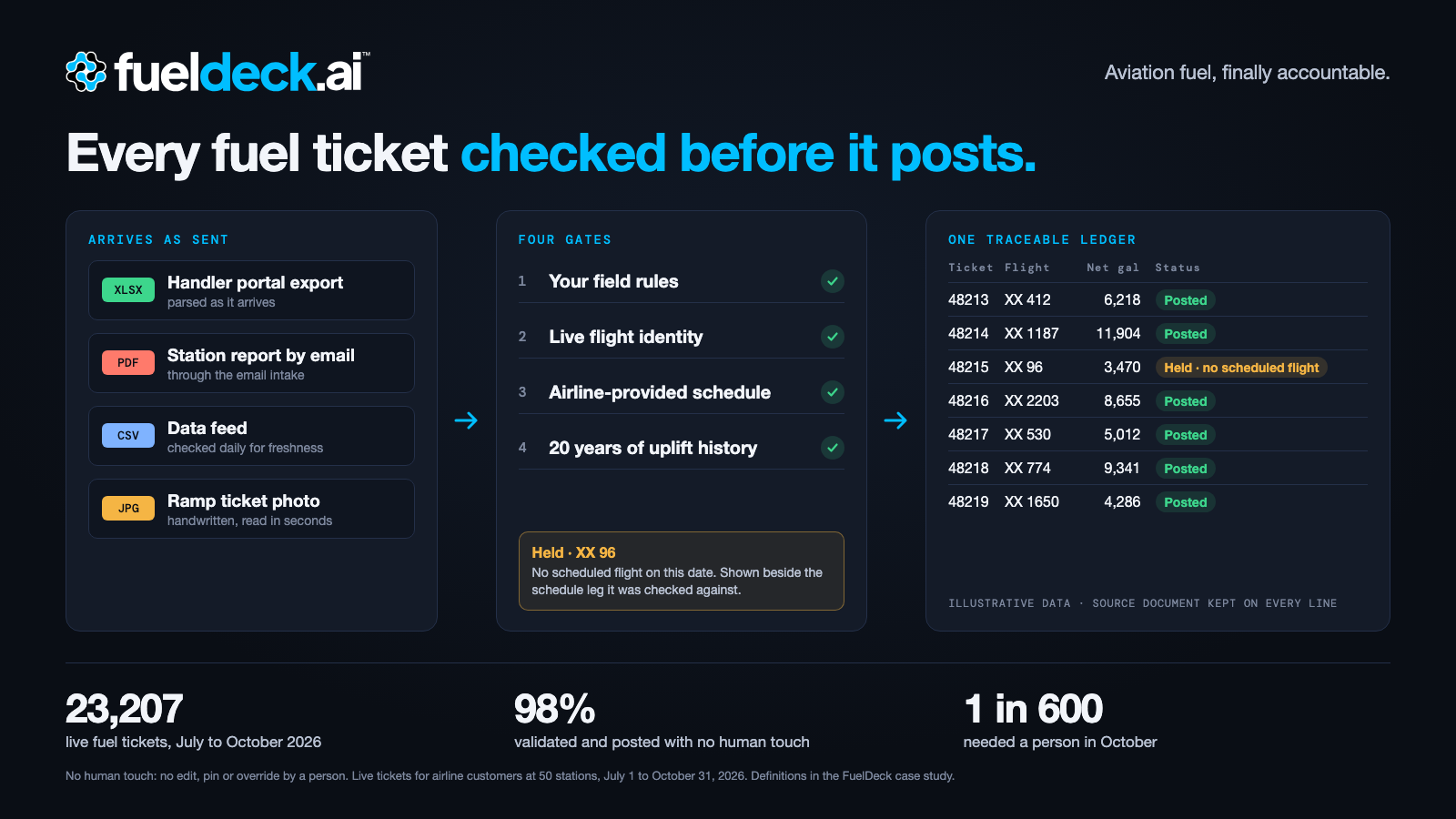

After 30 years of airline fuel accounting and more than 23,000 live tickets at 98% with no human touch, Logicraft ships AI that reads fuel records as they arrive, validates each against the scheduled flight and learns from every correction.
ENGLEWOOD CLIFFS, N.J. - iSportsWire -- Logicraft Corporation, the aviation fuel accounting firm founded by Avery J. Kraft in 1994, today announced the general availability of FuelDeck™ (https://fueldeck.ai), an AI-driven aviation fuel data platform that collects fuel records from handler portals, data feeds and email, reads them the way a fuel accountant would, checks every quantity and flight detail, and delivers traceable data to the teams and systems that reconcile and account for fuel. FuelDeck is built for fuel accounting teams at airlines, for into-plane fueling agents, and for airports and fuel consortia that still turn handler files, portal exports and ramp tickets into accounting by re-keying and spreadsheet reconciliation.
Every uplift of jet fuel produces a record, and it reaches the airline in whatever shape the handler's systems give it: an Excel or CSV export, a PDF report in an inbox, and for a significant share of uplifts a ticket written by hand at the wing. A 2026 Skymetrix study of 1.12 million airline fuel and airport-charge invoices across 31 airlines found that 40 percent still arrive as paper or unstructured PDF and are keyed by hand, and put the undetected errors airlines pay out at $4.6 billion a year.
Proven on live tickets before launch
Logicraft did not launch FuelDeck™ on a demonstration. From July 1 through October 31, 2026 it ran the platform on live fuel tickets for its airline customers, about 190 a day for 395 aircraft at 50 stations, most of them in North America and the Caribbean. Every ticket arrived as the Excel, PDF and CSV files handlers already produce; none was scanned at a desk. On September 23 full automation went live, with a stricter gate that matches every ticket to the airline's schedule. Every case an operator ruled on was built in as a standing rule, and by October tickets needing a person fell to 0.2 percent, one ticket in 600. Across 23,207 tickets, 98 percent were validated and posted with no human touch, and 348 tickets, 1.5 percent, needed a person's decision: a fuel day on an overnight flight, a tail number after an aircraft swap, a schedule mismatch to rule on. Those decisions took about six minutes of people's time a day. Every figure is read from the production database, not sampled, and the definitions behind each one are published in the case study, available from the contact below.
More on iSports Wire
"We spent three decades doing this work by hand for airlines, so we know exactly where the numbers go wrong and what an auditor asks for," said Avery J. Kraft, Founder and Chief Executive Officer of Logicraft Corporation. "The cost in fuel accounting does not sit in the ticket. It sits in the hand-off: the re-keying, the chargeback filed a month later, the second truck written off as a duplicate, the ticket a source quietly revises after it has posted. FuelDeck™ is that experience turned into software. Every rule in it was signed off by people who did this work by hand. When it holds a ticket, it says why. When it posts one, the evidence stays on the line, and every gallon traces back to its source document and to the flight it was pumped into."
"Reading the ticket was never the hard problem," said Ronny Kraft, Chief Technology Officer, who led the FuelDeck build from first prototype through launch. "The hard problem is proving it: that this uplift went onto this flight, on this tail, in this quantity, before a finance team pays for it. The AI in FuelDeck is trained on into-plane fuel tickets, and its work begins where extraction ends. It knows when it is unsure and sends the ticket to a person rather than guess, and every correction a reviewer makes teaches it, so a mistake fixed in October does not come back in November."
Reads the ticket as it actually arrives
At the core of FuelDeck is FuelScanner™, the capture engine that reads a fuel record in the form it arrives. In production today that is overwhelmingly the Excel, PDF and CSV files that into-plane agents' systems export; a file in a layout FuelDeck has not seen is held for review rather than parsed on a guess. When the record is the ticket itself, FuelScanner reads handwritten, printed, thermal and faxed tickets and ramp photographs, returning more than 32 structured fields in under three seconds, with 99.9 percent accuracy on the four fields that decide the invoice: fuel temperature, API gravity, density and net gallons. Any field it is unsure of goes to a one-click human review with the original in view.
Four gates before anything posts
FuelCounter™ runs every ticket through four validation gates before it can be posted: the customer's own field rules; a flight-identity check against live departure data; a mandatory match against the airline-provided schedule; and an anomaly screen against two decades of uplift history for that route and aircraft type. A ticket that fails a gate is held with the reason, beside the schedule leg it was checked against. Gross, net and metered quantities are compared only on the appropriate basis, and a re-sent report, a corrected ticket and a second truck on one flight are told apart.
More on iSports Wire
One ledger, and AI that keeps learning
A ticket that passes posts to a single ledger that feeds inventory reconciliation, receipts and transfers, station close, and dashboards by airline, airport and route. Every posted line keeps its source document, the review decisions and the delivery status. A ticket held because the flight written on it never operated is re-matched against the airline's schedule and heals onto the flight that actually fuelled, often within minutes. A person stands at every gate: nothing heals past a material difference in quantity, and nothing becomes a rule without sign-off. VersoData™ lets a fuel accountant ask the ledger a question in plain English and get a table or a chart back.
Records flow in automatically through a dedicated email intake, secure file transfer and direct connections to into-plane agent portals. Validated records leave in the A4A and IATA standard XML that fuel management and accounting systems expect, so finance teams keep their existing systems of record.
The full FuelDeck™ suite
FuelDeck™ already supports operations at more than 480 airports and over 726 million gallons of jet fuel a year.
Nothing to install
FuelDeck runs in the cloud, so there is nothing to install and no implementation programme to fund. Pricing is per ticket with volume tiers, so cost tracks the work actually done. It runs on Google Cloud with per-tenant isolation and data encrypted in transit and at rest.
Availability
FuelDeck™ is available today at https://fueldeck.ai. Airlines, into-plane agents and airports can request an exploratory call or a live demonstration on their own tickets by contacting rkraft@logicraft.com.
About Logicraft Corporation
Founded in 1994 by Avery J. Kraft, who leads the company today as Chief Executive Officer, and based in Englewood Cliffs, New Jersey, Logicraft Corporation provides aviation fuel accounting, reconciliation, and data services to airlines and fuel operators. FuelDeck™ is that three-decade practice turned into software. Learn more at https://fueldeck.ai and https://logicraft.com.
Every uplift of jet fuel produces a record, and it reaches the airline in whatever shape the handler's systems give it: an Excel or CSV export, a PDF report in an inbox, and for a significant share of uplifts a ticket written by hand at the wing. A 2026 Skymetrix study of 1.12 million airline fuel and airport-charge invoices across 31 airlines found that 40 percent still arrive as paper or unstructured PDF and are keyed by hand, and put the undetected errors airlines pay out at $4.6 billion a year.
Proven on live tickets before launch
Logicraft did not launch FuelDeck™ on a demonstration. From July 1 through October 31, 2026 it ran the platform on live fuel tickets for its airline customers, about 190 a day for 395 aircraft at 50 stations, most of them in North America and the Caribbean. Every ticket arrived as the Excel, PDF and CSV files handlers already produce; none was scanned at a desk. On September 23 full automation went live, with a stricter gate that matches every ticket to the airline's schedule. Every case an operator ruled on was built in as a standing rule, and by October tickets needing a person fell to 0.2 percent, one ticket in 600. Across 23,207 tickets, 98 percent were validated and posted with no human touch, and 348 tickets, 1.5 percent, needed a person's decision: a fuel day on an overnight flight, a tail number after an aircraft swap, a schedule mismatch to rule on. Those decisions took about six minutes of people's time a day. Every figure is read from the production database, not sampled, and the definitions behind each one are published in the case study, available from the contact below.
More on iSports Wire
- TCA VG: 2025 Funding Climbs to $9M across 43 Companies; Cumulative Returns Reach 5.3 MOIC & 22% IRR
- Searching for the Next LBE Creator: CalArts Launches First-Ever D.R.E.A.M.S. Pitch Competition
- Integris Composites Joins International Sea Power Conference Aboard HMS Prince of Wales
- Commercial Sales Launch Following FDA Approval; National Sales Force Now in Action as January Shipments and Major Market Opportunity Take Shape
- Seapines AI Releases ReelLife Hockey v1.4.0 Beta With Find My Player
"We spent three decades doing this work by hand for airlines, so we know exactly where the numbers go wrong and what an auditor asks for," said Avery J. Kraft, Founder and Chief Executive Officer of Logicraft Corporation. "The cost in fuel accounting does not sit in the ticket. It sits in the hand-off: the re-keying, the chargeback filed a month later, the second truck written off as a duplicate, the ticket a source quietly revises after it has posted. FuelDeck™ is that experience turned into software. Every rule in it was signed off by people who did this work by hand. When it holds a ticket, it says why. When it posts one, the evidence stays on the line, and every gallon traces back to its source document and to the flight it was pumped into."
"Reading the ticket was never the hard problem," said Ronny Kraft, Chief Technology Officer, who led the FuelDeck build from first prototype through launch. "The hard problem is proving it: that this uplift went onto this flight, on this tail, in this quantity, before a finance team pays for it. The AI in FuelDeck is trained on into-plane fuel tickets, and its work begins where extraction ends. It knows when it is unsure and sends the ticket to a person rather than guess, and every correction a reviewer makes teaches it, so a mistake fixed in October does not come back in November."
Reads the ticket as it actually arrives
At the core of FuelDeck is FuelScanner™, the capture engine that reads a fuel record in the form it arrives. In production today that is overwhelmingly the Excel, PDF and CSV files that into-plane agents' systems export; a file in a layout FuelDeck has not seen is held for review rather than parsed on a guess. When the record is the ticket itself, FuelScanner reads handwritten, printed, thermal and faxed tickets and ramp photographs, returning more than 32 structured fields in under three seconds, with 99.9 percent accuracy on the four fields that decide the invoice: fuel temperature, API gravity, density and net gallons. Any field it is unsure of goes to a one-click human review with the original in view.
Four gates before anything posts
FuelCounter™ runs every ticket through four validation gates before it can be posted: the customer's own field rules; a flight-identity check against live departure data; a mandatory match against the airline-provided schedule; and an anomaly screen against two decades of uplift history for that route and aircraft type. A ticket that fails a gate is held with the reason, beside the schedule leg it was checked against. Gross, net and metered quantities are compared only on the appropriate basis, and a re-sent report, a corrected ticket and a second truck on one flight are told apart.
More on iSports Wire
- ViewDNS.info Launches Monitors, Alerting Teams the Moment Something Changes on Their Domains
- Philadelphia-Area Entrepreneur Nouho M Kanneh Builds $37 Million Net Worth Across Real Estate, E-Commerce and Retail
- Contracting Resources Group Named a 2027 Elev8 GovCon Honoree by OrangeSlices
- The World's No.1 Superstar® Brings Christmas Back in Grand Style with Music, Cinematic Glamour, and Luxury Fashion
- New Six-Figure Media Agreement Builds Powerful Momentum, Expanding Government Contracts, FBI Access and Growing AI Recognition: Cyabra (NAS DAQ: CYAB)
One ledger, and AI that keeps learning
A ticket that passes posts to a single ledger that feeds inventory reconciliation, receipts and transfers, station close, and dashboards by airline, airport and route. Every posted line keeps its source document, the review decisions and the delivery status. A ticket held because the flight written on it never operated is re-matched against the airline's schedule and heals onto the flight that actually fuelled, often within minutes. A person stands at every gate: nothing heals past a material difference in quantity, and nothing becomes a rule without sign-off. VersoData™ lets a fuel accountant ask the ledger a question in plain English and get a table or a chart back.
Records flow in automatically through a dedicated email intake, secure file transfer and direct connections to into-plane agent portals. Validated records leave in the A4A and IATA standard XML that fuel management and accounting systems expect, so finance teams keep their existing systems of record.
The full FuelDeck™ suite
- FuelScanner™ (available now): capture of fuel records from handler files to handwritten tickets and ramp photos.
- FuelCounter™ (available now): four-gate validation, posting, inventory reconciliation, receipts and transfers, station close, and dashboards.
- VersoData™ (available now): plain-English questions over the ledger, with tables and charts back.
- DutyCounter™ (coming H2 2026): duty and recovery reporting built from the same flight and fuel record.
- FuelTaxPRO™ (coming 1H 2027): aviation fuel tax reporting from the same ledger.
FuelDeck™ already supports operations at more than 480 airports and over 726 million gallons of jet fuel a year.
Nothing to install
FuelDeck runs in the cloud, so there is nothing to install and no implementation programme to fund. Pricing is per ticket with volume tiers, so cost tracks the work actually done. It runs on Google Cloud with per-tenant isolation and data encrypted in transit and at rest.
Availability
FuelDeck™ is available today at https://fueldeck.ai. Airlines, into-plane agents and airports can request an exploratory call or a live demonstration on their own tickets by contacting rkraft@logicraft.com.
About Logicraft Corporation
Founded in 1994 by Avery J. Kraft, who leads the company today as Chief Executive Officer, and based in Englewood Cliffs, New Jersey, Logicraft Corporation provides aviation fuel accounting, reconciliation, and data services to airlines and fuel operators. FuelDeck™ is that three-decade practice turned into software. Learn more at https://fueldeck.ai and https://logicraft.com.
Source: Logicraft, Corporation
0 Comments
Latest on iSports Wire
- The Villari Firm, PLLC Named to the 2027 Edition of Best Law Firms
- The Bike Shifts Itself: Iowa Company Launches Automatic Shifting on Kickstarter
- Bacchus Wine & Spirits and Michelin Guide–Recommended Ethel's Fancy to Host Exclusive LOUIS XIII Limited Edition Diwali Decanter Celebration
- Arizona Pest Control Surpasses $200,000 in Contributions to Southern Arizona High School Sports and Education Programs
- BetQL Inserts a Human Connection to Sports Betting Through Live Shows
- Annotation Support Launches Football Annotation Tool for Player Tracking, Eventing, and Quality Control
- ZenaTech (NAS DAQ: ZENA) $1 Million in New Utility Contracts- Potential $2.5 Million Follow-On Opportunity Puts Its Drone Business in the Spotlight!
- New Patient Data Show REQORSA® Activating Cellular Repair Pathways as Roche Collaboration Advances Precision Lung Cancer Strategy for Genprex, Inc
- Genuine Hospitality, LLC Selected to Operate Holiday Inn Express & Suites Jacksonville – Town Center
- Shiokly Launches Online Marketplace to Help Singapore Home-Based Businesses Sell More, With First Product Listed Free
- Freight Broker 911 and Milton Collier Introduce "What's The 911?"—A New Podcast Built on Real Talk, Real Freight, and Real Opportunity
- PropAccount.com Launches PropWallet, Turning Prop Firm Payouts Into Repeat Sales
- KOLBUS America, For All Of Your Hycorr Equipment And Service Needs
- Heritage at Hopewell Announces New 3.875% Year-One Mortgage Rate Buydown Incentive on Quick Delivery Townhomes (7.11% APR)
- New TROP2 Research Breakthrough Strengthens REQORSA® Gene Therapy Story as Roche Collaboration Advances Precision Lung Cancer Treatment: Genprex, Inc
- Rent a Truck or Hire Movers? New Data Shows Fuel Now Makes Up to 40% of DIY Moving Costs
- 7th Annual RACE INDUSTRY WEEK Returns Nov. 30 – Dec. 3 With Free Live Webinars From Racing Leaders
- Club Wyndham Research Identifies the "Holiday Rewind Effect": 93% of Parents Recreate Their Own Childhood Holidays for Their Kids
- IEI Rugged IP66 Panel PC Brings Real-Time Visibility to Heavy-Duty Mining Fleets
- FDA Approval; Major Milestone for Preservative-Free Ketamine Ahead of FDA Goal Date for Treatment of Suicidal Depression by NRx Pharmaceuticals, Inc